
Abandoned Cart Recovery for Shopify: Why Klaviyo Misses Revenue in 2026
Most Shopify stores do not have an abandoned-cart copy problem. They have an identification problem.
The flow can be perfect. The timing can be right. The discount can be sensible. But if Klaviyo never identifies the shopper, the flow never fires.
That is the leak this guide focuses on. Not another list of subject-line tricks. Not another reminder to send three emails instead of two.
The real question is simpler: how many abandoners did your recovery setup actually see?
Baymard’s research still puts cart abandonment at roughly 70%. Venon’s product data and customer work point to the next layer: many stores running Klaviyo still miss a large share of recoverable carts because browser tracking breaks before the flow can trigger.
This guide shows where the leak comes from, why it got worse after iOS14, and how to fix it without rebuilding your existing Klaviyo setup.
The real abandoned-cart leak is identification, not email copy
If Klaviyo identifies the shopper, your existing flow has a chance. If it does not, nothing happens.
That sounds obvious, but it changes how you should audit the problem. Most teams open Klaviyo and start editing the emails. Better subject line. Shorter delay. Bigger discount. Cleaner design.
Sometimes that helps. But it only helps the carts Klaviyo already sees.
The larger opportunity is usually below the email layer: Safari cookie limits, iOS privacy changes, ad blockers, in-app browsers, and cross-device sessions all reduce the number of shoppers your flow can identify in the first place.
So before you rewrite another abandoned-cart email, compare three numbers: carts Shopify saw, carts Klaviyo identified, and carts that actually entered the flow.
What Is Abandoned Cart Recovery?
Cart recovery is catching shoppers who added to cart but didn’t check out, then nudging them back via email, SMS, ads, or popups.
It’s the highest-ROI email flow most Shopify stores run.
Why? Because the prospect already wanted the thing. They picked the variant. They typed in their shipping address. They almost paid.
Per Baymard, about 70% of carts get abandoned across industries. So for every 100 carts you build on your store, 70 walk away.
Win back even 10 of them and you’ve added 10% to your conversion rate. That stacks fast.
There are three layers to the recovery problem.
Did your tracking see the cart? Can you match the cart back to an email? Can you reach the shopper while they still care?
Most stores obsess over the third layer. Email copy. Subject lines. Discount stacking. The clever stuff.
The bigger gains live in the first two. Almost nobody talks about them.
Here’s why that matters. If your tracking misses the cart, no amount of clever copy will save you. The flow doesn’t fire. The shopper gets nothing. They forget about the brand by Tuesday and buy from your competitor on Wednesday. Game over before you ever picked a subject line.
The 5 Types of Cart Recovery for Shopify
5 channels do cart recovery on Shopify: email, SMS, WhatsApp, retargeting ads, and on-site popups. Each catches the shopper at a different moment.
You don’t need all 5. Most mature stores run 2 or 3.
Pick based on your audience. Email-heavy list with older customers? Email plus retargeting. Younger SMS-native US crowd? Email plus SMS. Selling into Latin America, India, or Southeast Asia? Email plus WhatsApp. Popups go on top of any of these, never instead.
Think of the 5 channels as 5 different points in time.
Email lands in their inbox hours after the cart goes cold. SMS pings their phone minutes after they bail. WhatsApp lands in their messaging app 1 to 2 hours later, in markets where WhatsApp dominates. Retargeting catches them on Instagram 2 days later. Popups catch them on your own site before they’ve left.
Layer all 5 badly and you create the digital equivalent of being followed home from the supermarket. Hunted, not reminded.
Cover the decision window. Don’t carpet-bomb it.
Each channel pulls a different share of the recovery weight.
Email does the heavy lifting by a wide margin. A solid Klaviyo flow recovers more abandoned cart revenue than the other 4 combined for most stores I see.
SMS bolts on top in US-heavy markets. It works best as the second touch when email number 1 doesn’t open.
WhatsApp does the same job as SMS, but in markets where WhatsApp is the default messaging app. Latin America, India, much of Southeast Asia, big chunks of Europe. If your customer base lives there, WhatsApp can outpull SMS.
Retargeting has lost ground. iOS14 cut your audience size 30 to 70%, depending on your traffic mix. You spend more to reach the same people. Useful as a backstop, no longer the engine.
Popups aren’t really recovery. They grab the email before the cart even gets abandoned, which feeds the email channel. Think prevention.
All 5 of these depend on one thing: your tracking actually seeing the cart in the first place. If iOS14 strips the cart event before any of these tools see it, none of them recover anything.
That’s the gap the rest of this guide is about.
Email flows
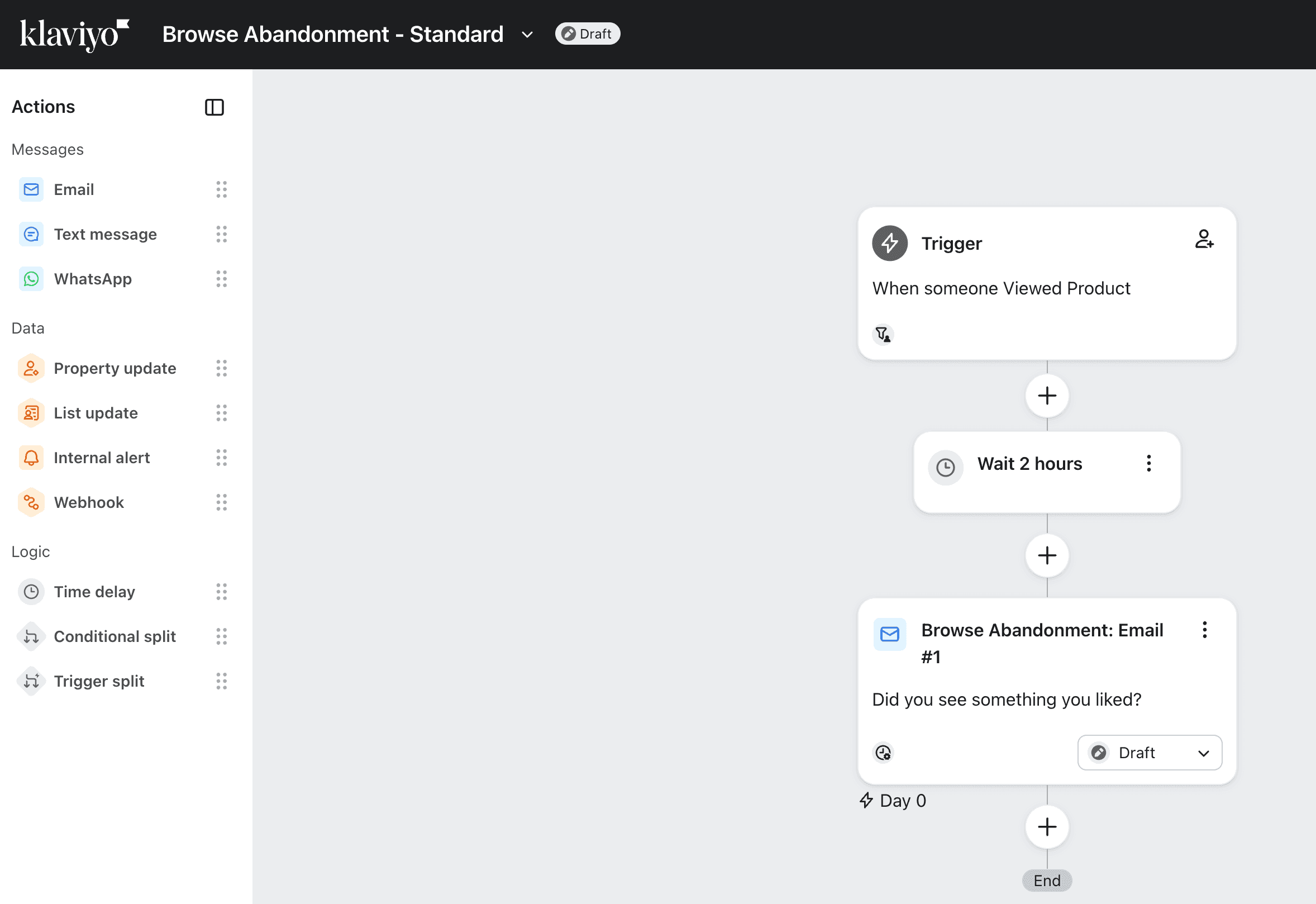
Email is the workhorse. Klaviyo (or Shopify Email if you’re early) firing a 3 to 4 step flow when cart_created or checkout_started fires.
Recovery rates land in the meaningful chunk territory when the flow is dialed in. The trick is that Klaviyo only sees carts where it identifies the shopper. Since iOS14, that pool has been shrinking every year.
For copy, timing, and discount strategy, see our Klaviyo Abandoned Cart Flow Complete Guide.
SMS flows
Klaviyo SMS gets ridiculous open rates. 90%+ in most studies. The catch is that opt-in is mandatory under TCPA in the US, and similar rules elsewhere.
Best play: one SMS 1 to 2 hours after the first email fails. Not a full SMS-only sequence.
SMS shines as a backup channel. It does not replace email.
WhatsApp messages
Klaviyo and a handful of WhatsApp-first tools now support cart recovery via WhatsApp Business templates. Open rates rival SMS, often 90%+. The overhead is heavier: pre-approved message templates, opted-in subscribers only, and a stricter regulatory layer than SMS.
Best fit if you sell into Latin America, India, Southeast Asia, or any market where WhatsApp is the default messaging app. For US-only stores, SMS still wins on reach.
Like SMS, treat it as a backup to email, not a primary channel. One template message 1 to 2 hours after abandonment, fired only to opted-in subscribers.
Klaviyo’s docs walk through the WhatsApp abandoned cart setup.
Retargeting ads
Meta and Google retargeting used to be the unsung hero of cart recovery.
Then ATT shipped. Most pixel-based retargeting audiences got cut to ribbons overnight. Audiences are 30 to 70% smaller now. You pay more for the same reach.
Server-side Meta CAPI and proper Shopify Google Ads conversion tracking are the floor in 2026, not the ceiling.
On-site popups and exit-intent
Justuno, Privy, OptinMonster. They fire popups when the shopper looks like they’re about to leave. The popup grabs the email before the cart’s even abandoned.
That isn’t recovery. That’s prevention.
Useful. Don’t count their revenue twice.
Why Shopify’s Default Cart Recovery Is Leaking Revenue
The default Shopify plus Klaviyo setup recovers a cart only when 2 conditions hold. The shopper’s email is on file or gets captured pre-abandonment. AND their browser lets your tracking scripts run long enough to fire the cart event.
Per Apple’s App Tracking Transparency policy, around 40% of mobile sessions opt out of cross-site tracking. Intelligent Tracking Prevention (ITP) restricts what stays in the browser even for the ones who don’t opt out. Apple’s policy details live in their developer documentation.
The result is simple.
Shopper opens your store on their iPhone. Adds to cart. Closes Safari. Klaviyo never sees the cart event.
No event. No flow trigger. No email.
Even if that shopper has bought from you 12 times before. The flow won’t fire because Klaviyo no longer knows who that customer is.
Klaviyo’s documentation walks through how identification depends on browser tracking. Their published benchmarks show identification rates dropping every year since 2021.
Cross-reference that with the cart count Shopify itself records, and the gap averages around 40% of recoverable carts going untriggered.
What this looks like in dollars
A $100K/mo Shopify store on Klaviyo is typically losing around $20K/mo in recoverable revenue, because iOS14 strips the tracking signals before Klaviyo can see the cart. That’s $240K a year leaving the building, just from the identification gap.
There are 4 patterns where Klaviyo loses the cart:
What Klaviyo can’t see on its own
- ✗Carts from shoppers who close the browser before the identification signal lands
- ✗Sessions that ITP flags as non-human on iOS14+ Safari
- ✗Shoppers who add to cart on phone, then check out on desktop later
- ✗Anything from in-app browsers (Instagram, TikTok, Facebook)
None of these are Klaviyo’s fault. Your flow is fine. Your copy works.
The break is one layer below, in the data feed.
Venon’s Klaviyo Recover plugs the 40% of carts Klaviyo can’t see on its own. $99/month, 10-minute setup, 60-day money back. See how Klaviyo Recover works.
Same customer, two outcomes
Picture a shopper who entered their email last week, clicked a Meta ad today, added a product to cart on their iPhone, then closed Safari.
In the normal Shopify plus Klaviyo setup, the browser signal may be gone before Klaviyo connects that cart to the customer. No identified cart. No flow trigger. No email.
With Venon, the same shopper can be identified server-side. Venon only triggers the duplicated recovery flow when the original Klaviyo flow did not fire, so the customer gets reached without duplicate emails.
Same customer. Same Klaviyo flow logic. Different outcome because the identification layer changed.
How Server-Side Tracking Fixes the 40% Gap
Server-side tracking captures cart events on Shopify’s backend instead of the shopper’s browser. The browser can opt out, get blocked, or get hosed by ITP. Your server doesn’t care.
The event fires. It carries the shopper’s email. Klaviyo gets it. Your existing flow triggers like nothing was wrong.
Read our Shopify server-side tracking guide for the technical mechanics.
This is what Venon does. Shopify app install, UTM tweak, done in about 10 minutes. Server-side capture starts the next morning.
Klaviyo Recover is the specific feature. It’s an add-on to the base tracking that pipes recovered carts back into your existing Klaviyo flows.
It doesn’t touch your flows. It doesn’t ask you to rebuild anything. It just makes the invisible carts visible again.
Across 100+ Shopify stores running Klaviyo Recover, the lift averages 40% more abandoned cart emails sent and 20% more flow revenue.
That 20% revenue lift typically pays for the entire tool many times over in month one.
A specific case from earlier this year. A Shopify cosmetics brand doing around $200K/mo on Klaviyo had recovered cart revenue of roughly $24K/mo, a hair under 12%. They turned Klaviyo Recover on. Two weeks in, recovered revenue was at $29K/mo. So $5K extra per month, against $99 a month in tool cost. They did not change a single line of email copy. The flow just started firing on the carts it never used to see.
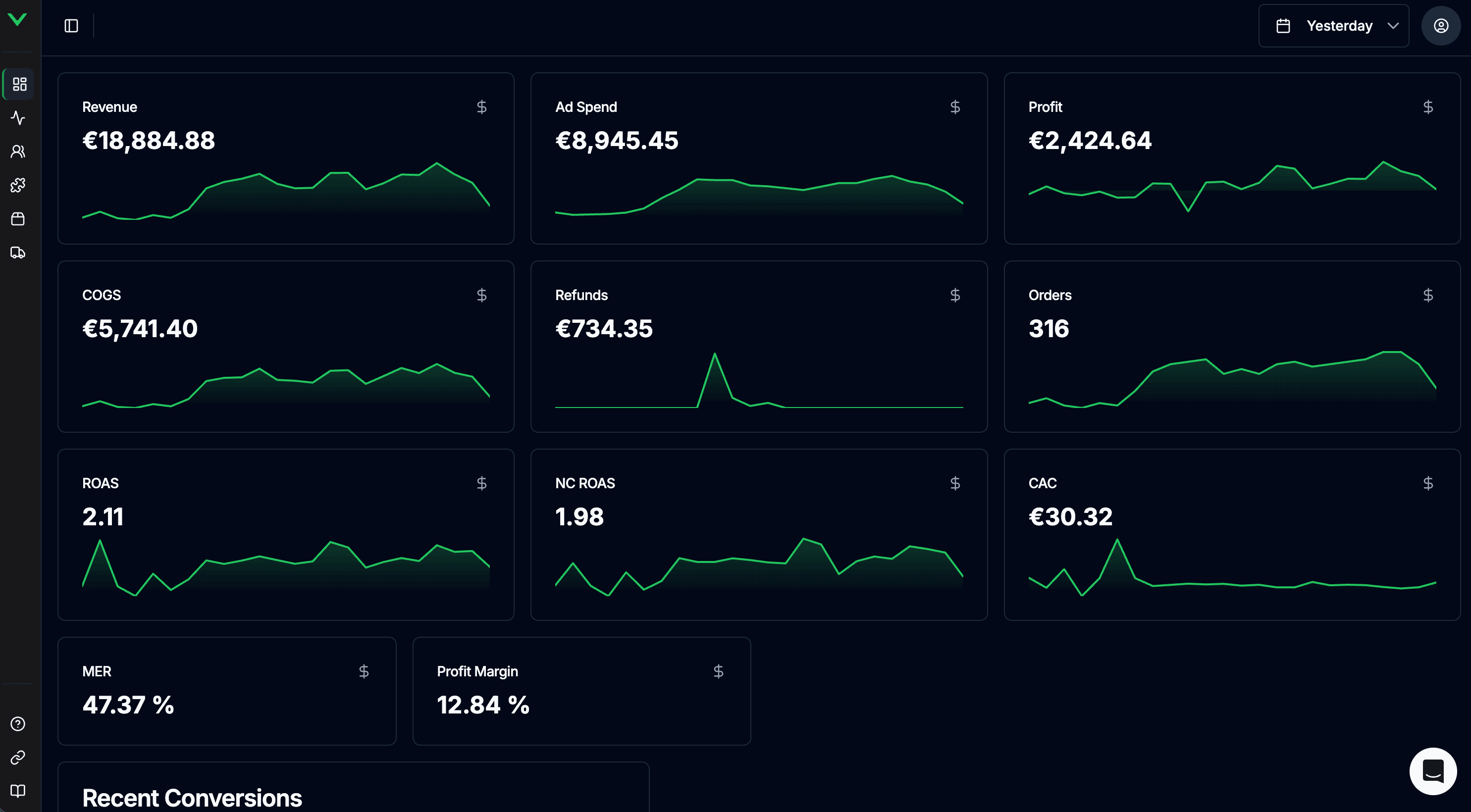
Ideal for: Shopify stores on Klaviyo doing $50K+/mo who want every recoverable cart, not just the 60% Klaviyo can identify. One customer recovered an extra 40% of abandoned carts within 2 weeks of switching it on.
One detail that throws people off: the data lands the next morning, not in real time.
That’s deliberate. The nightly job stitches server-side events with Klaviyo identification cleanly. Real-time would be noisier and miss roughly 5% of edge cases.
What this looks like in real stores
The point is not to send more email for the sake of sending more email. The point is to reach opted-in shoppers your store already earned but Klaviyo could not identify at the moment of abandonment.
Venon case-study data shows the size of that gap. DeskSpace saw 48.6% more Klaviyo flow revenue in the first month after installing Venon Klaviyo Recover. Vue saw 33.5% more flow revenue over 30 days. Across observed Klaviyo Recover accounts, the average extra flow revenue is 32.7%.
Treat those as case-study results, not a guarantee. The safe takeaway is still strong: if your existing flows already work, identifying more missed shoppers can turn the same Klaviyo setup into more recovered revenue.
Cart Recovery Tools Compared
Here’s the matrix of cart recovery tools that work with Shopify.
If you’re comparing the broader attribution layer too, start with our Triple Whale alternatives, Triple Whale pricing by GMV, and Hyros alternatives for Shopify guides. Both cover where analytics platforms help, and where cart recovery still needs a server-side Klaviyo feed.
Venon is at the top because Klaviyo Recover is the only thing on this list that solves the iOS14 identification gap without replacing your email tool. The others are useful, but they solve different problems.
| Tool | Best For | Starting Price | Free Plan | Works with Klaviyo | iOS14-Proof |
|---|---|---|---|---|---|
| Venon (Klaviyo Recover) | Once your Klaviyo flows are working, add this for the missing 40% | $99/mo | ✗ | ✓ | ✓ |
| Klaviyo (email + SMS) | Once you’ve outgrown Shopify Email and want real flows | $45/mo (email + SMS included) | ✓ | ✓ | ✗ |
| Shopify Email | Brand-new stores just turning cart recovery on | Free (first 10k) | ✓ | ✗ | ✗ |
| Postscript | Higher-volume SMS senders, alternative to Klaviyo SMS | $100/mo | ~ | ~ | ~ |
| Privy | Capturing emails pre-abandonment | $30/mo | ✓ | ✓ | ✗ |
| Justuno | Exit-intent popups | $39/mo | ✓ | ✓ | ✗ |
Prices as of April 2026.
A few honest takes on this table.
Klaviyo by itself is still the best email tool on Shopify. Not in dispute.
But “works with Klaviyo” and “iOS14-proof” are two different questions. Most tools nail the first. Almost none nail the second.
Shopify’s native Email tool is fine for stores under $20K/mo who just want flows running. Most brands outgrow it inside a year.
Postscript and the SMS players are playing a separate game. They’re additive to email, not a substitute. The “partial” marks reflect that they help in some scenarios and create message fatigue in others.
Privy and Justuno are about prevention, not recovery. They grab emails before the cart even walks. That shrinks the recovery pool, but it doesn’t fix anything that gets stripped after.
None of those 4 matter if Klaviyo can’t see the cart. That’s the real constraint.
The order of operations matters. Fix the tracking layer first. Then layer the channels on top. Stores that do this in reverse end up paying for tools that look like they should help, but actually solve the wrong problem.
How to Choose the Right Cart Recovery Setup
For most Shopify stores, the recommended stack is Klaviyo plus server-side recovery (Venon). That’s the floor. Everything else is optional.
Why this combo? Klaviyo’s the best email tool. Server-side tracking closes the 40% gap that Klaviyo can’t close on its own. Together they cover roughly 95% of recoverable carts.
You can layer SMS, popups, or paid retargeting on later. You can’t skip the floor.
Here’s how I think about it.
Diagnose the gap before you buy the tool. That’s the rule. Most stores skip this step and end up with 3 vendors who all assume the same broken tracking layer. Painful and expensive.
The cleanest path looks like this. You’re already on Klaviyo, your flow is dialed in, you want max recoverable revenue. Add Venon. 10-minute install, $99/mo, your existing flows stay untouched. Carts that were invisible last week start showing up this week. That’s it.
SMS comes later. Way later. Not until your email recovery rate is sitting at a clean 15% of cart revenue. Klaviyo SMS (or WhatsApp, depending on your market) on top of a leaky funnel is just expensive noise.
What if you’re still small? Under 1,000 orders a month means Shopify’s native Email is plenty. The identification ceiling isn’t your problem yet. Cross 1,000 orders, switch to Klaviyo. Add Venon when your flow revenue actually starts moving the P&L.
For abandoned cart recovery Shopify merchants in that early lane, simpler beats sophisticated. Every time.
Frequently Asked Questions
How much revenue does cart recovery typically recover?
Depends on the stack. A $100K/mo Shopify store running Klaviyo flows alone usually pulls 6 to 8% of cart revenue back, so roughly $7K. Layer server-side tracking on top of Klaviyo and you’re at 10 to 15%, so roughly $12K. The delta is what iOS14 hides from Klaviyo today.
Is Klaviyo enough for cart recovery on Shopify?
Yes, until you’re around $50K/mo. After that, no. Klaviyo can only act on carts it identifies. Since iOS14, that’s roughly 60% of sessions for most Shopify stores. The other 40% need server-side tracking feeding the events Klaviyo can’t see by itself.
Why do I need server-side tracking for cart recovery?
ATT, ITP, ad blockers, in-app browsers. Those four sources break around 40% of cart visibility for browser-based tracking. Server-side tracking sees the carts on Shopify’s backend, hands them to Klaviyo with the email attached, your existing flow takes it from there. No browser dependencies.
How many emails should be in an abandoned cart flow?
3 or 4. More starts hurting deliverability. Email 1 fires 1 to 2 hours in (reminder, no discount). Email 2 at 24 hours (soft incentive, social proof). Email 3 at 48 to 72 hours (real discount, urgency). Optional Email 4 at 5 to 7 days for late deciders. Past 4, you’re in spam territory.
When should the first recovery email send?
1 to 2 hours after abandonment. Not faster, that feels creepy. Not slower, you lose the impulse window. Browse abandonment is a separate animal. Fire those at 30 to 60 minutes, because browse intent decays faster than cart intent.
Does SMS convert better than email for cart recovery?
Better open rates. Worse conversion per message. Use email as your primary, layer one SMS touch 2 to 4 hours after abandonment as reinforcement. SMS-only is a mistake unless your audience is very young and very mobile-native. Even then, email plus SMS beats SMS alone.
Do I still need Venon if I already have Klaviyo?
Yes. Klaviyo handles the email side. Venon handles the tracking layer Klaviyo can’t see. Keep your existing flows. Stop leaving 40% of recoverable revenue on the table. $99/mo, 60-day money back. If it doesn’t pay for itself, you don’t pay.
Related reading
If you are comparing broader attribution tools, read Triple Whale Alternatives, Triple Whale pricing by GMV, and Hyros Alternatives. Both explain when an analytics suite makes sense and when a focused Shopify attribution plus Klaviyo recovery layer is enough.
6 Triple Whale Alternatives That Save 60% on Costs • Top Hyros Alternatives for Shopify Stores in 2026 • Triple Whale Pricing in 2026
Getting Started
The fix for Shopify cart recovery is short. Three steps. The whole thing takes maybe 30 minutes if you’re audit-ready, longer if you have to dig for numbers.
Step 1 is diagnostic. Open Klaviyo, look at what your current abandoned cart flow actually recovered last month, and put a number on the gap. Most teams skip this and start buying tools instead. Don’t.
Step 2 is finding where the leak is. Klaviyo’s view of carts and Shopify’s view of carts should roughly match. They almost never do. The delta is your recoverable revenue, just sitting there.
Step 3 is closing the gap. There’s exactly one durable fix for the iOS14 problem on Shopify, and it’s server-side tracking into Klaviyo. Everything else (different email tools, different SMS providers, more aggressive popup timing) is window dressing on the same broken signal.
Run through them in order. The audit tells you if you have a problem. The diagnostic tells you how big it is. The fix is the fix.
Step 1. Audit
Open Klaviyo. Pull your abandoned cart flow’s recovered revenue for the last 30 days. Compare it to total cart value in the same window.
Under 10%? Your flow needs work, either copy or tracking. 10 to 15%? Email is fine, but the iOS14-hidden 40% is still costing you.
Step 2. Find the leak
Compare how many cart events Klaviyo received last month against how many carts Shopify itself recorded (Analytics > Checkouts).
Klaviyo seeing meaningfully fewer carts than Shopify? That delta is the recoverable revenue you’re not triggering on. For most stores, it’s 30 to 50% of all carts.
Step 3. Fix it
Server-side tracking into Klaviyo is the standard fix. Venon does it in 10 minutes of setup, runs on German GDPR-compliant servers, and is backed by a 60-day money-back guarantee covering the entire product (Klaviyo Recover included).
If it doesn’t pay for itself in 60 days, you don’t pay.
A note on what happens once it’s running. Most stores see the recovered cart count climb inside the first week, because Klaviyo starts firing flows on carts it never used to see. The flow revenue line in your Klaviyo dashboard ticks up. Nothing in your existing setup changes. You just stop bleeding the 40% you were bleeding before.
For deeper reading, see our pillar on the best ad tracking software for ecommerce and the sibling guide on Klaviyo abandoned cart flows.
Book a free 15-minute Klaviyo audit. We’ll calculate exactly how many carts your current setup is missing, what that adds up to in monthly revenue, and whether Venon would pay for itself for your specific store size. No obligation, no credit card. Book your free audit.